
From a little beachfront café in Cyprus to the extraordinary world of arcade emulation, revisiting the games that made growing up in the 1980s so much fun.
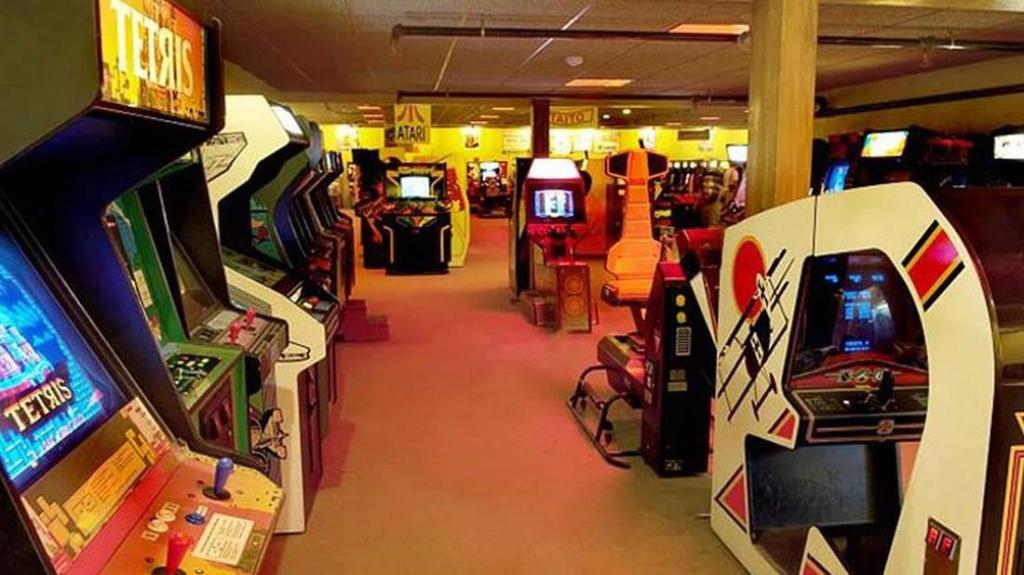
Ten Machines and a Pocketful of Change
Somewhere in Cyprus, back in the mid-1980s, there was a little beachfront café and shop on a British military base. If you grew up as a military kid, you’ll probably know the sort of place I’m talking about.
Inside were around ten arcade machines.
Ten glorious, noisy, brightly coloured machines that seemed purpose-built to separate children from their pocket money.
And they were remarkably good at it.
Looking back, there was something wonderfully Back to the Future and The Terminator about the whole experience. This was the 1980s, when technology felt exciting, futuristic and full of possibilities. And to a kid standing in front of those glowing screens, that’s exactly how those machines felt.
The graphics, the sounds, the flashing lights and the sheer variety of games available were extraordinary.
One minute you could be fighting your way through a fantasy dungeon, the next you were racing a Ferrari along a coastal road or desperately trying to survive an alien invasion.
And all it took was another coin.
The machines weren’t cheap to play, and they certainly weren’t designed to let you win easily. Some were ridiculously difficult. Others felt almost impossible.
But that didn’t matter.
There was always another game to discover, another high score to chase, another reason to put your hand in your pocket.
It was cool. It was fun. And, perhaps most importantly, it was an escape.
I returned to that part of Cyprus in 2023 and again in 2024. Nearly forty years have passed since those childhood days, but the memories of those arcade machines remain remarkably vivid.
And thanks to a remarkable piece of software called MAME, many of those games are still there waiting to be played.
The Games That Kept Me Coming Back
Ask anyone who grew up around amusement arcades during the 1980s and 1990s, and they’ll probably have a list of games that consumed far more of their pocket money than they’d care to admit.
I certainly do.
Gauntlet (1985) — A Fantasy Adventure

As a kid, I loved fantasy role-playing games, particularly Middle-earth Role Playing.
So when Gauntlet appeared, it was almost inevitable that I’d be drawn to it.
Here was the opportunity to become a warrior, wizard, valkyrie or elf, battling through dungeons filled with monsters, treasure and seemingly endless danger.
It was wonderful.
I played Gauntlet both in the arcades and on my Commodore 64, and it was one of those games that seemed to capture the spirit of fantasy adventure perfectly.
The arcade version was particularly memorable, with multiple players able to join forces against hordes of enemies.
Of course, the game had a rather effective way of keeping you spending money. Your health was constantly draining, and surviving often meant feeding the machine another coin.
But when you were surrounded by ghosts, desperately trying to reach the next exit, you weren’t thinking about the economics of arcade gaming.
You were thinking about staying alive.
Out Run (1986) — The Joy of the Open Road

I suspect just about every kid of my generation played Out Run at least once.
And honestly, how could you resist?
A bright red Ferrari, beautiful coastal scenery, an unforgettable soundtrack and the opportunity to drive as fast as possible towards the next checkpoint.
It was arcade escapism at its finest.
What made Out Run special wasn’t simply the racing. It was the atmosphere.
The colourful scenery, the sense of speed and the music combined to create something that felt much bigger than a straightforward driving game.
And the challenge was deceptively simple.
Get to the next checkpoint before the clock runs out.
That’s it.
No enormous open world. No complicated missions. No hundreds of hours of content.
Just you, a Ferrari, a road and a rapidly disappearing timer.
And somehow, all these years later, there’s still an enormous amount of satisfaction in trying to beat it.
Yie Ar Kung-Fu (1985) — One More Fight

Another game I spent a lot of time playing was Konami’s Yie Ar Kung-Fu.
Long before the enormous popularity of modern fighting games, this was offering players the chance to battle a succession of increasingly challenging martial arts opponents.
You controlled Oolong, fighting your way through enemies with different techniques, weapons and fighting styles.
It was simple to understand, but mastering it was another matter entirely.
Timing, movement and learning how each opponent attacked were essential.
And naturally, just when you thought you were getting good, along came someone who seemed determined to prove otherwise.
It was addictive in that wonderfully frustrating arcade way.
Lose a fight, convince yourself you knew exactly what you’d done wrong, and immediately want another go.
Galaga (1981) — Memories of Ayia Napa

Galaga holds a particularly special place in my memories.
I used to play it on a tabletop arcade machine in a beachfront restaurant in Ayia Napa, Cyprus.
Unlike the more familiar upright cabinets, this machine had its screen set beneath a glass tabletop. You sat down to play, looking directly into the screen below you.
It was a lovely way to experience an arcade game.
And Galaga was perfect for it.
The concept was straightforward enough: control your spacecraft, destroy waves of attacking aliens and try not to get blown to pieces.
But the movement patterns of the enemies, the increasingly frantic action and the constant temptation to improve your score made it incredibly compelling.
There was something almost hypnotic about it.
And even now, whenever I think about Galaga, I don’t simply remember the game.
I remember that restaurant, the beach and being a kid in Cyprus.
That’s something special about video games. Sometimes they become inseparable from the places and people we associate with them.
Metal Slug (1996) — Pixel Art at Its Finest

Moving into the 1990s, one game I kept returning to was Metal Slug.
And what a game it was.
The first thing that struck me was the artwork.
Even today, I think Metal Slug looks absolutely gorgeous.
The wonderfully detailed pixel graphics, beautifully animated characters, explosions, vehicles and background scenery gave the game an extraordinary amount of personality.
Everything seemed alive.
The soldiers reacted comically, the tanks bounced and rattled, and the explosions were wonderfully over the top.
But underneath all that visual charm was a relentlessly challenging run-and-gun shooter.
And it was incredibly addictive.
You’d make a little more progress, discover something new, get blown up and immediately want to start again.
It was one of those games where the developers had managed to combine beautiful artwork with genuinely enjoyable gameplay.
For me, it’s a perfect example of why pixel graphics shouldn’t automatically be dismissed as outdated.
Good artwork is good artwork, regardless of how many pixels are involved.
The Graphics Have Aged. The Gameplay Hasn’t.
Let’s be realistic.
Compared with modern gaming, those old arcade machines are technologically ancient.
Today, we have extraordinarily powerful consoles and computers capable of producing enormous, beautifully realised worlds.
Games such as Grand Theft Auto and Assassin’s Creed offer incredible experiences, with cinematic storytelling, detailed environments and levels of immersion that would have seemed like science fiction to a kid standing in front of an arcade cabinet in the mid-1980s.
And I love that.
Modern gaming can be absolutely fantastic.
But here’s the thing.
There’s still something immensely satisfying about trying to beat Out Run.
There’s still that determination to survive another wave in Galaga, defeat another opponent in Yie Ar Kung-Fu, or make it a little further through Gauntlet.
And then there’s Metal Slug, whose wonderfully detailed artwork and gloriously chaotic gameplay remain a joy to experience.
These games didn’t need enormous open worlds or complicated progression systems.
Their appeal was immediate.
You understood what you needed to do, even if actually doing it was another matter entirely.
Some were brutally difficult. Some were almost impossible. And yes, some were clearly designed to keep you feeding coins into the machine.
But the best of them had something that transcended their technical limitations.
They were challenging, addictive and, above all, fun.
Modern games can transport you into another world.
Classic arcade games can make you forget about the world for ten minutes.
Both are wonderful achievements, just in very different ways.
Enter MAME — Bringing the Arcade Home

For those of us who grew up playing arcade games, the arrival of MAME was something rather special.
MAME originally stood for Multiple Arcade Machine Emulator.
The project began in 1997, with the aim of recreating the hardware behaviour of arcade machines through software, allowing games originally designed for dedicated arcade systems to run on modern computers.
For many Windows users, one of the most recognisable ways of experiencing it was MAME32, which provided a graphical interface for browsing and launching games.
And suddenly, something rather wonderful became possible.
Games that had once required expensive arcade cabinets, and a seemingly endless supply of coins, could be revisited on a home computer.
Gauntlet. Out Run. Galaga. Yie Ar Kung-Fu. Metal Slug.
The games were familiar, but the experience had changed.
No longer did every mistake mean another trip into your pocket.
You could practise. Experiment. Learn the levels and understand the mechanics.
You could finally spend time exploring games that, as a child, you might only have been able to afford a few minutes with.
Of course, MAME doesn’t perfectly recreate the atmosphere of an amusement arcade.
There’s something about standing in front of a real cabinet, hearing the sounds of other machines around you, and gripping those original controls that a keyboard or modern controller can’t quite reproduce.
But MAME offers something equally valuable.
It gives us the opportunity to experience the games themselves again.
And there’s another important reason why it matters.
More Than Nostalgia — Preserving Gaming History
MAME isn’t simply a way for older gamers to relive their childhoods.
It’s also an important preservation project.
Arcade machines were built around specialised hardware, much of which is now decades old.
Circuit boards deteriorate. Components fail. Machines are scrapped, damaged or simply disappear.
Without efforts to document and emulate that hardware, some games could eventually become extremely difficult, or even impossible, to experience in their original form.
MAME works to preserve the behaviour of those systems, helping document an important part of computing and entertainment history.
And that matters.
Because video games are part of our cultural history.
They reflect the technology, creativity and entertainment of the periods in which they were developed.
From the simple but wonderfully addictive action of Galaga to the extraordinary pixel artwork of Metal Slug, these games tell a story about how the industry evolved.
MAME helps ensure that story isn’t forgotten.
Fancy Another Go? Downloading MAME
If reading this has made you want to revisit some of those old arcade favourites, the modern MAME project is still actively developed.
Although many of us remember the older MAME32 name, the current software is simply known as MAME.
It’s free, open-source software, and the latest official releases can be found here:
Official MAME download: https://www.mamedev.org/release.html
You can also learn more about the project and its preservation work at:
Official MAME website: https://www.mamedev.org/
An Important Note About ROMs and Copyright
While MAME itself is free and legal to download, the arcade game software it emulates is a separate matter.
The original games, often stored and distributed as ROM files, generally remain protected by copyright.
Just because a game is old, no longer commercially available or described as abandonware does not mean it is automatically legal to download or distribute.
Users should ensure they have the necessary rights or permission to use any game ROMs.
Some games have been officially released for free or made available under licences that permit their use, but these should not be confused with unauthorised copies of commercial games.
HERA Magazine International does not host, distribute or link to unauthorised ROM downloads.
For more information about MAME and its requirements, visit the official documentation:
One More Credit?
It’s strange how certain memories stay with you.
I can still remember those arcade machines in Cyprus, the excitement of choosing what to play, and the frustration of watching another game end far sooner than I’d hoped.
I remember the tabletop Galaga machine in Ayia Napa.
I remember battling through dungeons in Gauntlet, trying to reach the next checkpoint in Out Run, and being completely captivated by the artwork in Metal Slug.
And I remember just how much fun it all was.
The world of gaming has changed beyond recognition since those days.
We have incredible consoles, enormous virtual worlds and technology that would have been almost unimaginable back then.
But there’s still a place for those old arcade games.
Not because they were necessarily better than what we have today, but because the best of them understood something fundamental about entertainment.
Sometimes, all you need is a simple idea, a good challenge and the determination to have just one more go.
The graphics may have aged, the arcades may have disappeared, but the magic of putting in another credit?
Somehow, that’s still there.


Leave a Reply