
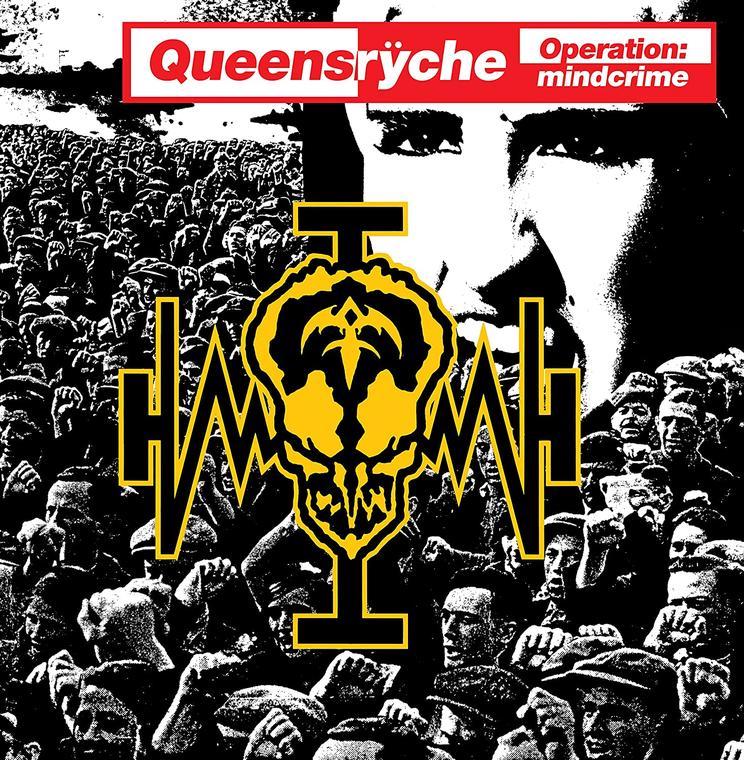
Artist: Queensrÿche
Album: Operation: Mindcrime
Released: 1988
Genre: Progressive Metal / Heavy Metal
I Should Have Hated This Album
I should have absolutely fucking hated Operation: Mindcrime.
Back in the day, I was firmly in the thrash metal camp. Metallica, Exodus, Kreator and Megadeth were my bands. I was one of those ridiculous “death to false metal” purists, convinced I knew exactly what heavy metal should sound like.
And Queensrÿche? With their soaring vocals, melodic guitar work and elaborate concept albums? They weren’t exactly what I was looking for.
Then somebody played me Operation: Mindcrime.
I didn’t immediately rush out to buy it. I didn’t suddenly abandon thrash metal or have some grand musical revelation.
Instead, something rather strange happened.
I started humming guitar solos.
Not riffs, not choruses, but actual guitar solos. Little passages of melody that had somehow lodged themselves in my head. The frustrating thing was that I couldn’t work out where the hell they came from.
It took me about a week to realise they were from Operation: Mindcrime.
And that was it. I was hooked
When the Music and the Story Become One
Released in 1988, Operation: Mindcrime is a concept album following Nikki, a disillusioned young man drawn into a world of political conspiracy, manipulation, addiction and murder.
At the centre of the story is Dr X, a shadowy figure who exploits Nikki’s anger and dissatisfaction, turning him into a weapon for his own ideological ambitions.
There’s also Sister Mary, whose relationship with Nikki gives the story much of its emotional weight.
It’s an ambitious concept, and one that could easily have gone horribly wrong.
Concept albums sometimes suffer because the musicians become so preoccupied with telling a story that they forget to write memorable songs. Others have excellent individual tracks but a narrative that feels awkwardly bolted together.
Operation: Mindcrime suffers from neither problem.
Every track has a purpose. Every musical passage feels like it belongs. The songs work as music, but together they build something much greater.
From the urgency of Revolution Calling and the menace of Operation: Mindcrime to the atmosphere of The Mission, the drama of Suite Sister Mary and the emotional release of Eyes of a Stranger, the album moves with remarkable confidence.
And crucially, there’s no filler.
I don’t find myself waiting for a weaker song to finish so I can get to the good stuff. The entire record matters.
Neither the story nor the music feels sacrificed for the sake of the other. That’s an extraordinary achievement.
Chris DeGarmo: A Guitarist Who Understood the Brief
As someone who played guitar myself, one of the things I came to appreciate most about Queensrÿche was Chris DeGarmo.
I genuinely believe he’s one of the most underrated guitarists of his generation.
The 1980s produced no shortage of guitarists determined to demonstrate how many notes they could squeeze into a solo. Technical ability was often treated as a competitive sport.
DeGarmo was different.
He could certainly play, but he never struck me as someone interested in showing off simply because he could.
His solos had melody, structure and purpose. They complemented the songs rather than interrupting them.
Alongside Michael Wilton, he helped create guitar arrangements that could be heavy, intricate, atmospheric and remarkably accessible, sometimes within the same song.
And those melodies stayed with you.
They certainly stayed with me.
The fact that I found myself unconsciously humming his solos before I even knew where they came from says more about his musicianship than any discussion of technical proficiency ever could.
For me, a great guitar solo isn’t necessarily the fastest or most complicated.
It’s the one you remember.
And DeGarmo understood that beautifully.
Geoff Tate: An Extraordinary Voice
Then, of course, there’s Geoff Tate.
Queensrÿche’s subsequent history, including the less-than-amicable split between Tate and the band, is well documented. But whatever anyone thinks about those events, they cannot take away what Tate achieved on Operation: Mindcrime.
His vocal performance is astonishing.
The range, the power, the control and the sheer theatricality of his delivery are essential to the album’s success.
But what makes his performance so impressive isn’t simply his ability to hit extraordinary notes.
It’s his ability to communicate emotion.
There’s anger, desperation, vulnerability, confusion and defiance throughout the record. Tate doesn’t merely sing the lyrics; he gives the characters and their circumstances a voice.
On an album built around a narrative, that matters enormously.
Without a singer capable of delivering those emotional shifts convincingly, Operation: Mindcrime could have become an elaborate but rather hollow exercise.
Instead, Tate makes you believe in the story.
And whatever happened later, this was Queensrÿche with the classic line-up operating at an exceptional level.
An Album That Still Has Something to Say
Here’s where Operation: Mindcrime becomes more than simply an album I enjoy.
I’ve always been a cynical person.
I’ve never been particularly comfortable accepting something simply because somebody in authority tells me it’s true. I’ve always wanted to know why. I’ve always questioned people’s motives, and when I see something I genuinely believe is unfair, I’ve never been especially good at keeping quiet about it.
That’s probably got me into trouble on more than one occasion.
But it’s also part of who I am.
And the lyrics of Operation: Mindcrime resonated with that side of me.
The album explores political corruption, manipulation, ideological fanaticism and the way powerful people can exploit the anger and frustrations of others.
It’s about people being sold promises, encouraged to believe they’re fighting for something worthwhile, and ultimately used by those with their own agendas.
Sound familiar?
Nearly four decades after its release, those themes remain depressingly relevant.
The politicians change. The slogans change. The methods of communication change. But the manipulation, dishonesty and willingness to exploit people’s fears and frustrations haven’t disappeared.
That’s why I believe the album is genuinely timeless in its concept.
It doesn’t need to predict a particular political event or identify a particular villain to remain relevant. It’s examining something much more fundamental about power and human behaviour.
And, strangely enough, I think albums like Operation: Mindcrime helped make me a better person.
Not because they told me what to think, but because they reinforced the importance of questioning what I was being told.
Of looking beyond slogans.
Of asking who benefits.
Of refusing to accept that something must be right simply because somebody powerful insists that it is.
For an album I should have hated, that’s quite an achievement.
Does It Still Hold Up?
Musically, Operation: Mindcrime is undoubtedly a product of its era.
You can hear the late-1980s production, the guitar tones, the dramatic arrangements and the scale of the performances.
But I don’t consider that a weakness.
An album doesn’t have to sound as though it was recorded yesterday to remain relevant or enjoyable.
What matters is whether the songs still work.
And for me, they absolutely do.
The guitar work remains compelling. Tate’s vocals remain remarkable. The arrangements are carefully constructed, the melodies are memorable and the narrative gives the whole record a sense of purpose.
More importantly, I can still listen to the album from beginning to end without wanting to skip anything.
That’s something I can’t say about many records, even ones I love.
The Verdict
Operation: Mindcrime is one of those rare albums where everything seems to come together.
The songwriting, musicianship, vocals, production and storytelling all contribute to a complete experience.
Chris DeGarmo’s guitar work remains a masterclass in melodic playing. Geoff Tate delivers one of the defining vocal performances of the era. And the album’s examination of power, manipulation and disillusionment remains as thought-provoking as ever.
But perhaps the greatest compliment I can pay it is that it changed my mind.
I was a stubborn thrash metal purist who should, by his own ridiculous rules, have dismissed Queensrÿche without a second thought.
Instead, their music got into my head, their lyrics made me think, and their album became something that has stayed with me for decades.
Sometimes the best music is the music that challenges your prejudices.
Nearly forty years after its release, I sat down and watched the official videos again. And when Eyes of a Stranger reached its conclusion, I still felt those same chills. For all the albums I’ve listened to over the years, very few can still do that to me.
HERA Rating: 9/10
No filler. No compromises. An extraordinary album that remains essential listening.


Leave a Reply