
From a teenager discovering photography in 1971 to an award-winning professional whose assignments have included Hollywood names, presidential visits and extraordinary personal stories, Gregory Geiger has spent more than five decades capturing moments that matter.

Photography has changed almost beyond recognition over the past fifty years. Film has given way to digital sensors, darkrooms to editing software, and artificial intelligence is now challenging the very nature of photographic imagery.
Yet for American photographer Gregory Geiger, known professionally as G3, something fundamental remains unchanged: the relationship between the photographer, the subject and the moment they create together.
His career has been anything but ordinary.
From newspaper photography and military filmmaking to television news, prestigious weddings and creative glamour photography, Gregory has developed an extraordinary breadth of experience. Along the way, his work has earned a Fuji Masterpiece Award and Kodak Gallery Awards, appeared in hundreds of magazines and taken him into the company of some remarkable people.
But despite the awards, famous names and technical accomplishments, Gregory’s greatest satisfaction comes from something much simpler: seeing someone look at a photograph and fall in love with the image.
HERA Magazine International caught up with Gregory to talk about his remarkable career, the artistry of glamour photography, the challenges posed by artificial intelligence and why a photograph can become more precious with every passing year.


The versatility of Gregory Geiger’s portrait and glamour photography.
The HERA Interview
HERA: Every photographer has a beginning. What first inspired you to pick up a camera, and was there a particular moment when you realised photography was going to become an important part of your life?
Gregory: In my sophomore year of high school in 1971, I was the manager of the baseball team. The local newspaper photographer would show up to shoot the games.
I said to him, “I’m going to get a camera and learn photography.”
He handed me a bulk roll of 35mm Tri-X and said, “Here’s your first roll of film. Show me what you do with it.”
Now I had to buy a camera!
My first camera was a Mamiya-Sekor 500-DTL. At the same time, I was reading the Time-Life series of books on photography, so I had a working knowledge of lighting, composition and how a 35mm camera worked.
My mentor turned out to be a retired owner of the third-largest independent advertising agency in New York City, so I had college-level mentorship!
Having my photos published in the local newspaper paid $4 a photograph in 1972.
I was hooked!
HERA: Your portfolio demonstrates remarkable versatility, moving between natural outdoor portraiture, classic glamour and highly stylised studio photography. Do you have a favourite genre, or is the opportunity to explore different photographic styles what keeps your creativity alive?
Gregory: Between newspaper photography, US Army 16mm film, television news photography, shooting high-end weddings and having a studio that rented out to other photographers, my experience level is pretty deep.
Being a professional photographer, to me, means that when a client hires you, you have the knowledge to complete the assignment to their satisfaction.
I enjoy the challenge of a client booking a studio shoot and verbally explaining what they would like from their images.
Now it’s backgrounds, their outfit, accessories, props, lighting, lens selection and camera angle, all coming together to deliver that first “OMG!” photograph.
Personally, I enjoy working with people to create a feeling of their personality.
Having a client relax will expose their soul to the camera.
There’s my happy place!

HERA: Lighting can completely transform a photograph. Some of your images feature beautifully soft, natural illumination, while others use dramatic shadows and striking colours. How do you approach lighting a shoot, and what have you learned over the years about creating atmosphere through light?
Gregory: “Photography is painting with light.” I would credit the person who first said it if I knew who that was!
Great photographs create emotions. I look to create impact with my images.
There are times when you shoot to make the client happy and times when you want to showcase the variety of your own work.
If I’m doing a collaboration with a model, she tells me what she has in mind for an outfit, location, theme or set idea.
I’m absorbing all this information and thinking, what can we create as a collaborative team to make those OMG photographs?
There are times when I light the set, we agree on the look of the photograph, and then a flash doesn’t fire.
Suddenly, that photograph has a completely different WOW factor.
I call those “happy accidents”.


Exploring mood, colour and personality through different approaches to portrait lighting.
HERA: You’ve received a Fuji Masterpiece Award and two Kodak Gallery Awards. Congratulations! Could you tell us about the photographs or projects that earned those awards, and what receiving that recognition meant to you?
Gregory: The Fuji Masterpiece Award was one I really had to work at!
I was shooting with a Hasselblad 503CX, photographing a moonrise over San Francisco.
In my head, I wanted the Golden Gate Bridge in the foreground, the city and a full moon rising above it.
For the time of year and when I was there, the photograph was going to require a double exposure, all done in-camera.
I had four film magazines exposed with the bridge and city just after sunset. I used a dark slide to cover half the lens so that only half the film was exposed.
Then I waited for the moon to rise and switched to a 150mm Sonnar lens for the moon photographs.
Doing this successfully meant using good landmarks in the ground-glass viewfinder and having some real skill — or luck — controlling the dark slide.
Out of the four exposures, the last frame worked and looked best.
The comment I usually received was that you normally see the Golden Gate Bridge with cloud cover, whereas this was a clear night.
The giveaway that it’s a double exposure? There’s no reflection of the moon on the water!
My first Kodak Gallery Award was for a photograph of a girl in a wedding dress on a beach.
It was a carefully planned photographic session, which was a team-building experience for a photographer who usually turned up, photographed the wedding and left.
I was fortunate to have a model nearly six feet tall, a couture gown from Christos and flowers supplied by the designer who created the floral arrangements for Martha Stewart’s first book.
So I was the weakest link!
We had only one day for the shoot, no studio, and it was a Connecticut beach with solid overcast skies.
I used a Hasselblad 503CX, a 120mm Planar lens and three Metz 60 CT-1 flashes.
The lighting consisted of main, fill and backlighting, set two f-stops below the ambient exposure so that the cloud layer retained its texture.
I was lucky, and honoured, that the Kodak selection committee considered the image worthy of Gallery recognition.
HERA: You’ve photographed models both in the studio and outdoors. The studio offers control, while outdoor locations introduce unpredictable light, weather and surroundings. Which environment do you find most creatively rewarding, and have you ever had an unexpected situation turn into a particularly memorable photograph?
Gregory: Living in New England, if you want to make a living, you have to shoot in a studio.
The winters are too cold for family, commercial or portfolio work outside, and July and August are high-humidity months.
Outdoor photography provides unique backgrounds, but it also requires more effort to control the lighting.
Studio work is a guaranteed source of income.
As I get older, I prefer working in the studio. There’s more control over the set, props, lighting and working with clients.
Walking half a mile or more along an uneven trail is for the young photographers!
One memorable photograph involved a fitness model during a beach shoot at sunset.
She was wearing a lace outfit and standing en pointe.
I had fill flash set two f-stops below the ambient light to fill in the shadows.
On the fourth and fifth exposures, the flash didn’t fire.
The resulting silhouette looked stunning!
Another happy accident.

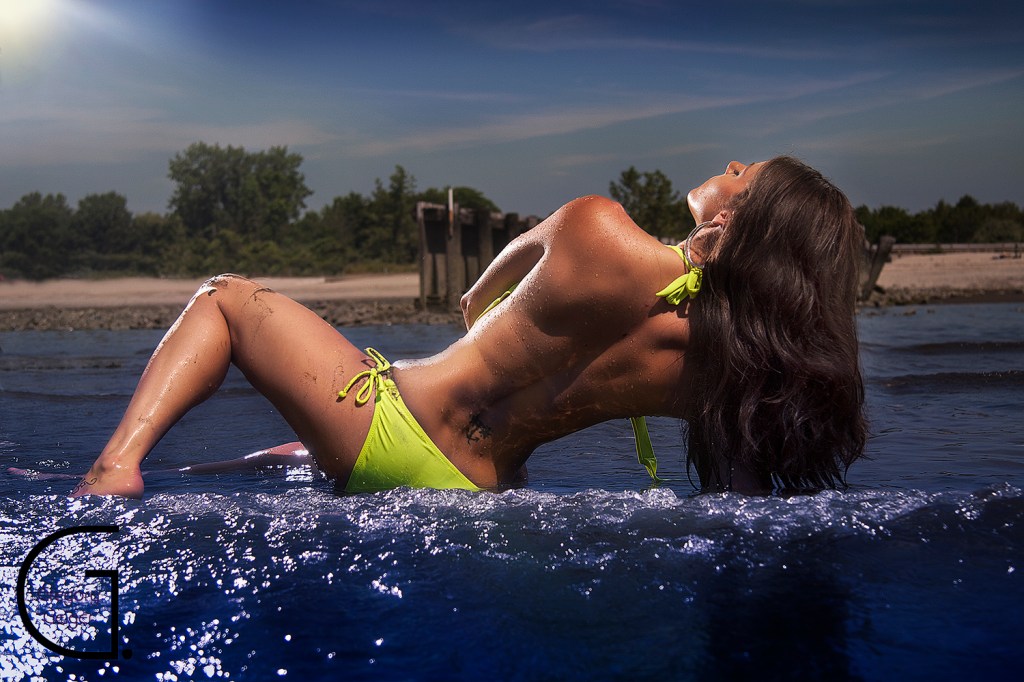

From location photography to fitness portraiture, Gregory combines technical control with expressive composition.
HERA: One of the things I particularly admire about your portfolio is the variety of personalities and moods you capture. How important is the relationship between photographer and model, and what do you do to help someone feel comfortable, confident and able to express themselves in front of your camera?
Gregory: This is a tricky area.
You need to build a relationship where the model trusts you, while at the same time respecting their life.
I’ve heard more than a few models complain about photographers who want endless telephone conversations.
My approach is simple: tell me what you want, tell me what I should know to give you an OMG photo session, and tell me what rules or boundaries you might have.
After that, it’s about creating photographs with a WOW factor.
Once a model trusts your abilities, they will pretty much let you create.
HERA: Your glamour photography ranges from timeless, understated portraits to bold, theatrical compositions. What makes a truly successful glamour photograph in your eyes, and how do you balance elegance, sensuality and artistic expression?
Gregory: Thank you for noticing the range of my photographs.
What makes a photograph “truly successful” is, I would suggest, based on age and knowledge.
What was considered glamour in the 1940s might be called bland today. Equally, some of what I see described as glamour now seems to lack depth and artistry.
In other words, beauty is in the eye of the beholder.
I learned photography through books. There was no YouTube in the 1970s!
To get a book published, it had to be well researched, written and fact-checked. YouTube doesn’t fact-check its videos.
There are two books featuring the lighting of George Hurrell that I would definitely recommend reading.
When working with a model, you listen to how she sees herself and then add the lighting to create that look.
Some businesses have the rule, “The customer is always right.”
At my studio, Studio 95 Photo, we have our own rule:
K.T.F.M.H. — Keep The F*in’ Model Happy!**


Classic beauty, delicate fabrics and expressive styling illustrate the diversity of Gregory’s glamour work.
HERA: Photography has changed enormously with digital cameras, sophisticated editing software and, more recently, artificial intelligence. How has your own creative process evolved with these developments, and where do you personally draw the line between photographic enhancement and fundamentally changing an image?
Gregory: First, who’s the client, what do they want, and are they paying you what you’re worth?
Recently, Adobe had an advertisement that said, “Skip the photographer.”
That’s where the photography industry is going.
With AI, it’s becoming a question of what you want to see in your graphic.
I’m losing business to AI, right now mostly headshots, where former clients send a few professional photographs to an AI service and have an entirely new look generated.
So far, families and models can’t get a quantity series of photographs through AI, or at least not that I’ve seen.
My standards are simple.
I won’t change your appearance so much that, if you have a print I made and then walk into the room, the two don’t look like the same person.
There are applications that allow a digital artist to completely reshape a body.
If that makes the client happy, get paid and say, “Thank you. Would you like another?”
But I’ll pass on providing that service.
That’s my personal standard.
HERA: Looking back over your photographic career, are there particular assignments, publications, models or photographs that stand out as defining moments? Perhaps there’s even a story behind one of your favourite images that people would never guess simply by looking at it.
Gregory: In high school, I had a classmate named Rachael, a senior transfer student who had modelling experience in her previous hometown.
I couldn’t take a bad photograph of her!
As a television news photographer, the stories I covered ranged from being aboard a fast-attack submarine to serving as the pool camera when President Ronald Reagan was in Connecticut.
I went flying with Bob Hoover a few times and made seven solo parachute jumps, either with a 16mm Bolex or a Canon AE-1.
My wedding assignments included Bill Gates’ engagement party in Cupertino, California, a personal shoot for George Lucas, and weddings ranging from 1,200 guests to just seven.
At the seven-guest wedding, the bride wrote in her thank-you card, “You were right. I didn’t notice you at the reception.”
My work appeared in bridal magazines including Elegant Bride and Modern Bride.
I never made it into Bride’s & Your New Home, but I was the only photographer invited to the founding editor’s retirement party!
In the early 1990s, Modern Bride magazine hired me to photograph the wedding featured in its nationwide contest.
The winning bride, Kate, lived in San Francisco and was thrilled to have her wedding featured in the magazine.
I flew out a few days before the event and met Kate, her wedding party, the vendors and visited the location.
At the same time, I networked with some of San Francisco’s top caterers and floral designers.

Six weeks after the wedding, there was a regional wedding planners’ convention. The organiser asked whether I could give an afternoon presentation on current trends in wedding photography.
So I returned to San Francisco with the proof book from Kate’s wedding and the mock-up pages from Modern Bride.
I revisited the vendors I’d previously met, and they could now see the quality of the wedding photographs.
A caterer and floral designer then recommended me for a job taking place three days after the conference.
It was Bill Gates’ engagement party.
That led to photographing George Lucas, which in turn led to a high-end wedding in San Diego.
One assignment really can lead to another!
HERA: Finally, after everything you’ve achieved, what still excites you about photography? Are there creative ambitions, photographic projects or subjects you haven’t yet explored, and what advice would you give to an aspiring photographer hoping to develop their own distinctive style?
Gregory: What still excites me?
Loading a roll of Kodak 35mm film into my Canon EOS 1N.
That feel and sound of a film camera.
Next to that, it’s a model scrolling through her images on the back of my Canon 5D Mark IV and saying, “Love, love, love! OMG! Have to show Mom!”
As photographers, we’re creating history.
As image-makers, we produce photographs for future generations to experience.
Whether it’s a model photograph at 21 years old, college graduation photographs, a wedding or subsequent family photographs, we’re documenting that person’s journey through time.
My work has been featured in four coffee-table books, countless wedding albums and a few hundred magazines, including Rangefinder, PPA’s Professional Photographer and bridal publications.
But the most meaningful photographs are the ones where grandchildren see Grandma in a beach shoot and tell her, “She looked hot once!”
You know Grandma won’t remember my name.
She’ll remember the experience.
Capturing More Than a Moment
For Gregory Geiger, photography has always been about more than cameras, lenses and lighting equipment.
His career has taken him from the baseball fields of his school days to award-winning landscapes, glamorous studios, prestigious weddings and assignments involving some of the world’s most recognisable names.
Yet after more than five decades, the excitement of loading a roll of film remains, as does the pleasure of watching someone discover a photograph of themselves that they truly love.
Perhaps that is what makes his perspective so compelling.
While technology continues to transform how images are created, Gregory reminds us that the real value of photography often emerges long after the shutter has clicked.
A photograph can preserve a fleeting expression, a special occasion or a version of ourselves that might otherwise exist only in memory.
And sometimes, the greatest reward for a photographer isn’t an award, a publication or a famous client.
It’s knowing that someone, somewhere, will treasure that photograph for years to come.
HERA Magazine International would like to thank Gregory Geiger for sharing his experiences, insights and remarkable photographic journey with our readers.
Photography: Gregory Geiger / Studio 95 Photo
With Special Thanks to Gregory Geiger
HERA Magazine International would like to extend our heartfelt thanks to Gregory Geiger for taking the time to share his remarkable journey with us.
From his earliest adventures with a camera to a career spanning more than five decades, Gregory’s stories have given us a fascinating glimpse into the life of a photographer whose passion for his craft remains as strong as ever.
We’re especially grateful for his generosity in allowing us to showcase his beautiful photography alongside this interview.
Gregory’s belief that photographs preserve memories for future generations is a wonderful reminder of why photography matters, and it’s been a genuine pleasure sharing his experiences with our readers.
To discover more of Gregory’s work, visit his Instagram:
All photography featured in this article is by Gregory Geiger / Studio 95 Photo.


Leave a Reply