
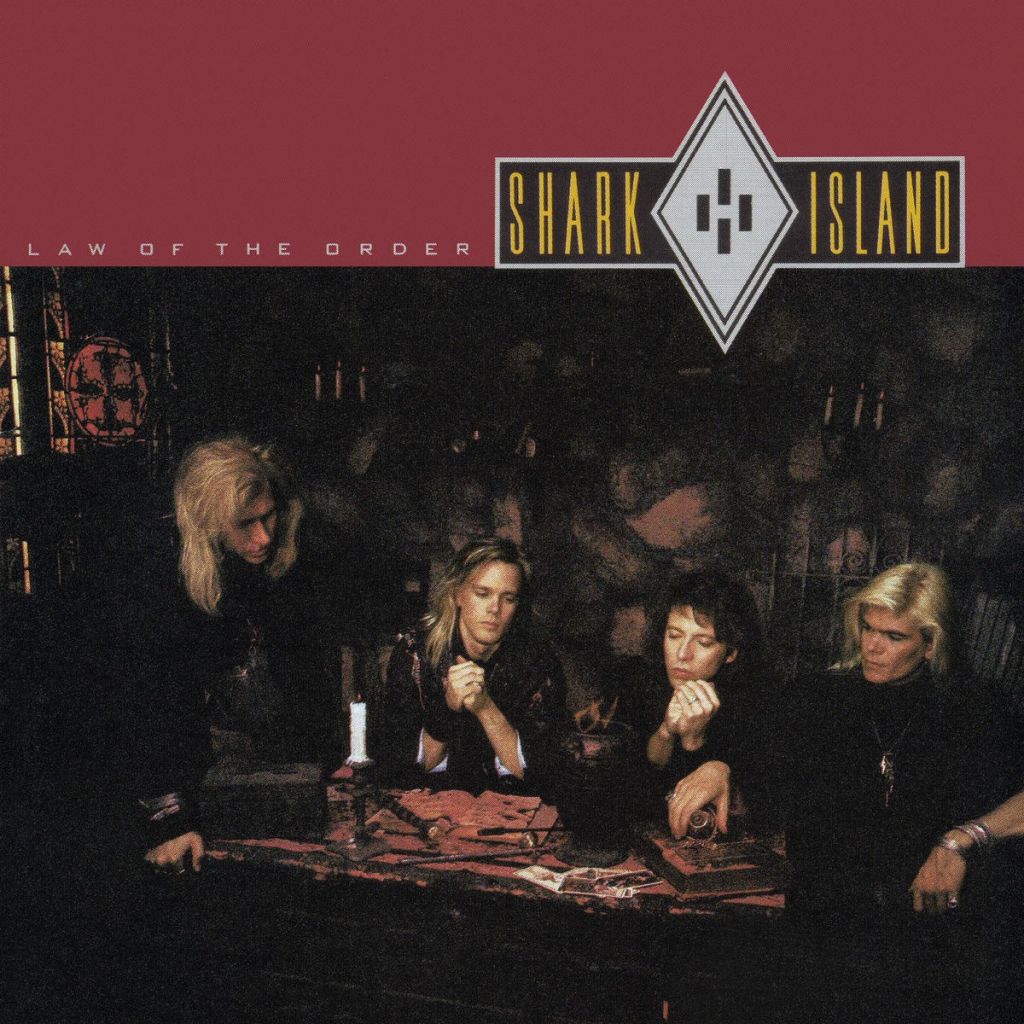
Released in 1989, Law of the Order should have been Shark Island’s opportunity to take their hard-earned Sunset Strip reputation to a much wider audience. Instead, it became one of those albums that slipped through the cracks of rock history. But more than three decades later, is it worth rediscovering?
An Unexpected Introduction
I first discovered Shark Island almost entirely by accident.
MTV was playing in the background when the opening of a song caught my attention. For a moment, I genuinely thought I was listening to Billy Idol.
Curious, I walked into the room to see what was playing.
It wasn’t Billy Idol.
Instead, I was greeted by a band I’d never heard of, performing a song called Paris Calling. Their frontman was Richard Black, a vocalist with something of Idol’s distinctive edge, but with a delivery that struck me as more refined, more controlled, and entirely his own.
He was one heck of a singer.
But it wasn’t simply his voice that caught my attention. It was the way he moved.
By then, audiences were already familiar with Guns N’ Roses frontman Axl Rose and his distinctive stagecraft. Yet here was Richard Black, displaying movements that seemed remarkably familiar.
At the time, I knew nothing about Shark Island’s history, their reputation on the Los Angeles club circuit, or the controversy that would surround comparisons between the two singers.
I simply knew I’d discovered a band worth listening to.
And the album that followed, Law of the Order, would become one of those records I felt deserved considerably more attention than it received.
Kings of the Sunset Strip
Shark Island’s story began long before Law of the Order appeared in record shops.
Formed in Los Angeles in 1979 by Richard Black and guitarist Spencer Sercombe, the group originally performed under the name Sharks. They released independent material before adopting the Shark Island name in the mid-eighties.
By then, they had established themselves as a formidable live attraction.
The band became closely associated with Gazzarri’s, one of the legendary clubs on the Sunset Strip. Their punishing performance schedule reportedly involved multiple shows a night, several nights a week.
This wasn’t a group that had been assembled in a recording studio and sent out to learn how to perform.
Shark Island had already spent years developing their craft in front of audiences.
And that experience mattered.
The Sunset Strip was an extraordinarily competitive environment. Bands such as Mötley Crüe, Ratt and Guns N’ Roses were helping define the sound and image of American hard rock.
But while some groups went on to international success, Shark Island remained better known to the audiences who had witnessed them firsthand.
Their live reputation was considerable. Their commercial breakthrough, however, proved far more elusive.
Richard Black and the Axl Rose Controversy
One of the most intriguing aspects of Shark Island’s history concerns the similarities between Richard Black’s stage movements and those of Axl Rose.
Black was already performing on the Los Angeles club circuit before Guns N’ Roses achieved international fame, and the resemblance between elements of their performances has generated discussion among rock fans for decades.
Richard Black has suggested that Rose was influenced by his stagecraft.
In interviews, Black has described visiting Rose and encountering a collection of VHS recordings of Shark Island performances, an account that has contributed to speculation about the origins of some of Rose’s distinctive movements.
But this is where a little caution is necessary.
Axl Rose has not, to my knowledge, publicly confirmed that Richard Black was an influence on his stage performance.
Furthermore, similarities between two performers do not, by themselves, establish that one copied the other.
Marc Canter, who documented the early Guns N’ Roses scene, has acknowledged the possibility of an influence while offering a more nuanced interpretation than the suggestion that Rose simply adopted Black’s entire performance style.
The chronology certainly makes the comparison interesting, but the extent of any influence remains disputed.
For me, the more important point is that Richard Black was an accomplished and charismatic performer in his own right.
He deserves recognition for that, regardless of what Axl Rose may or may not have borrowed.
And once you get beyond the stage movements, there’s the small matter of his extraordinary voice.
Law of the Order: More Than Eighties Attitude
Released through Epic Records in 1989, Law of the Order was Shark Island’s major-label debut.
It was not their first recorded album, but it represented their most significant opportunity to reach an international audience.
The line-up featured Richard Black on vocals, Spencer Sercombe on guitar, Chris Heilmann on bass and Greg Ellis on drums.
On the surface, the album contained many of the familiar ingredients of late-eighties American hard rock: powerful vocals, prominent guitars, big melodies and an unmistakable sense of theatricality.
But I think it would be a mistake to dismiss Shark Island as simply another hair-metal band.
Much of the hard rock of that era was built around attitude, appearance and the mythology of fast living.
There was nothing inherently wrong with that. Mötley Crüe and Skid Row, for example, each brought their own identity to the genre.
What appealed to me about Shark Island, however, was that they didn’t sound as though they were merely trying to keep up with everyone else.
They were unmistakably a product of their time, but they had developed a musical personality of their own.
Richard Black’s vocals were a major part of that identity, as was Spencer Sercombe’s approach to the guitar.
And, crucially, there were songs beneath the image.
The Songs That Stayed With Me
For me, three tracks stand above the rest: Paris Calling, Somebody’s Falling and Why Should I Believe.
Other listeners will undoubtedly have different favourites, and I wouldn’t pretend that my choices represent any universal consensus.
But these are the songs that have stayed with me.
Paris Calling
Paris Calling will always occupy a special place in my appreciation of Shark Island because it was the song that introduced me to the band.
That opening was enough to make me stop what I was doing and walk into another room to find out who was singing.
There was something instantly recognisable about Black’s vocal character, yet it quickly became apparent that this wasn’t simply a Billy Idol impersonation.
Black had his own identity, and the song provided an excellent introduction to it.
It also demonstrated why Shark Island could hold their own in a musical landscape crowded with charismatic singers and accomplished musicians.
For a band trying to make the leap from the Sunset Strip to the wider world, it was a compelling opening statement.
Somebody’s Falling
Somebody’s Falling is another of the album’s highlights for me.
One of the things I appreciate about Shark Island is that their music doesn’t always depend on the familiar themes of excess and rock-and-roll bravado.
There is room for a different emotional character in their songs, and Somebody’s Falling is one of the tracks I find myself returning to.
It’s also a good example of what makes the partnership between Black and Sercombe interesting.
Neither musician needs to dominate every moment. What matters is how their contributions work together.
Why Should I Believe
At over five minutes, Why Should I Believe is the longest original composition on the album.
It’s also one of my personal favourites.
Again, what appeals to me is that Shark Island weren’t simply relying on attitude to carry the material.
The combination of Black’s distinctive voice and Sercombe’s musical approach gives the song its own character.
For me, it demonstrates that there was more to this band than the image associated with the Sunset Strip.
And that, ultimately, is what separates Law of the Order from some of the more disposable releases of its era.
Spencer Sercombe: More Than Just a Guitar Hero
The late eighties were hardly short of extraordinary guitarists.
Steve Vai, Paul Gilbert and Nuno Bettencourt were among those demonstrating just how far the electric guitar could be pushed technically.
Spencer Sercombe, however, offered something rather different.
That’s not to suggest he lacked ability. Quite the opposite.
What makes his playing interesting is its diversity and the way it complements the songs.
Rather than treating every opportunity as an excuse for another dazzling display of fretboard gymnastics, Sercombe sounds like a guitarist who understands the importance of the musicians around him.
He isn’t some isolated guitar monolith, standing apart from the rest of the band and demanding that everyone admire his technical prowess.
He’s part of what makes Shark Island work.
And then there’s his connection to one of heavy metal’s most recognisable instruments.
The B.C. Rich Warlock Connection
The B.C. Rich Warlock is one of the most visually outrageous electric guitars ever produced.
For anyone unfamiliar with it, imagine a guitar designed entirely from sharp angles, and then imagine somebody deciding it still wasn’t quite pointy enough.
The super pointy guitar with added pointiness.
But its origins have an intriguing connection to Spencer Sercombe.
According to accounts of the instrument’s development, B.C. Rich founder Bernardo Rico had created an angular guitar design that remained pinned to his workshop wall.
Rico reportedly considered it one of the ugliest designs he’d ever created.
Sercombe spotted the sketch, liked what he saw, and encouraged Rico to turn it into an actual instrument.
The Warlock subsequently entered production in the early eighties and became one of the defining guitar shapes of the heavy-metal era.
It’s a wonderful piece of rock history.
And there’s something rather fitting about the contrast between the instrument and the musician.
The Warlock was flamboyant, aggressive and almost comically extravagant in appearance.
Sercombe’s playing, meanwhile, often demonstrated considerably more restraint than the guitar’s appearance might suggest.
The Album That Might Have Been
Perhaps one of the most revealing details in Shark Island’s history concerns the album Epic Records didn’t want to release.
The band had recorded a live performance at the Whisky a Go Go in July 1989, intended for release as Bastille Day Alive at the Whisky.
For a group whose reputation had been built on the strength of its live performances, the idea made considerable sense.
But Epic reportedly considered a live major-label debut too risky and favoured a conventional studio album instead.
The result was Law of the Order.
Richard Black has subsequently expressed reservations about whether the studio recording fully captured the band as audiences experienced them on stage.
And that raises an interesting question.
Did Shark Island’s record company overlook the very quality that had made the band special in the first place?
It’s impossible to know whether a live debut would have changed their commercial fortunes.
After all, a great live band doesn’t automatically translate into a commercially successful recording act.
But the decision illustrates the difficulty Shark Island faced in moving from an established club reputation to the wider record-buying public.
The music industry wanted an album it could market.
Shark Island had spent years developing an experience that was perhaps harder to capture in a studio.
Beyond the Album: Hollywood and Contraband
Although Law of the Order didn’t transform Shark Island into household names, their music did find its way into some surprisingly familiar places.
Dangerous and Father Time appeared in the 1989 film Bill & Ted’s Excellent Adventure, while My City was featured in the 1991 action film Point Break.
That means listeners may have encountered Shark Island without ever knowing the band’s name.
Their music reached Hollywood audiences even as the band struggled to achieve the recognition enjoyed by some of their Sunset Strip contemporaries.
Richard Black would also become involved in Contraband, the short-lived hard-rock supergroup featuring Michael Schenker, Tracii Guns, Bobby Blotzer and Share Pedersen.
The project released an album in 1991, but it didn’t provide the lasting commercial breakthrough that had eluded Shark Island.
A Band Caught Between Two Eras
Timing can be everything in music.
Shark Island had spent years establishing themselves in Los Angeles, but Law of the Order arrived in 1989, towards the end of the decade that had helped shape their sound and image.
By that point, the American hard-rock market was already crowded.
Guns N’ Roses had achieved enormous success, while numerous other bands were competing for record-company investment, radio exposure and MTV airtime.
Then, in September 1991, Nirvana released Nevermind.
The arrival of grunge didn’t bring eighties hard rock to an immediate halt, despite the way that period is sometimes remembered.
But it did help accelerate a dramatic shift in popular taste, media attention and record-label priorities.
Suddenly, the flamboyance and theatricality associated with the Sunset Strip were no longer fashionable in quite the same way.
For bands still trying to establish a mainstream audience, the change could be devastating.
Shark Island were particularly unfortunate because they had already invested years in building their reputation, yet their major-label recording career was still relatively young.
Of course, it would be too convenient to blame Nirvana for everything.
Law of the Order had been released roughly two years before Nevermind. Its failure to become a major commercial success cannot be explained entirely by the arrival of grunge.
Competition, promotion, record-company decisions and the challenge of translating Shark Island’s live appeal into a studio recording all deserve consideration.
Nevertheless, the changing musical landscape certainly didn’t make their situation any easier.
They had spent years preparing for a breakthrough, only to find that the industry was beginning to move in another direction.
The Chain and the Rest of the Record
The album closes with Shark Island’s interpretation of Fleetwood Mac’s The Chain.
Covering such a recognisable song was an interesting decision, particularly on a record intended to establish the band’s own identity.
The remainder of the album includes Shake for Me, Bad for Each Other, Passion to Ashes, Spellbound, Get Some Strange and Ready or Not.
Together, these tracks demonstrate the band’s place within the late-eighties hard-rock tradition.
Not every song has remained as memorable to me as my three personal favourites, and I wouldn’t suggest that Law of the Order is an album without weaknesses.
But there’s enough individuality in its performances, particularly from Black and Sercombe, to make it worthy of rediscovery.
It isn’t necessary to declare every overlooked album a forgotten masterpiece.
Sometimes, recognising a record’s strengths and understanding why it mattered is a more meaningful tribute.
Final Thoughts: More Than a Footnote in Rock History
When I first heard Paris Calling playing on MTV, I had no idea who Shark Island were.
I certainly didn’t know about their years on the Sunset Strip, the questions surrounding Richard Black’s influence on Axl Rose, or Spencer Sercombe’s connection to the B.C. Rich Warlock.
I just heard a voice that made me stop what I was doing.
That remains my strongest memory of discovering the band.
Looking back, what strikes me about Law of the Order is that Shark Island didn’t need to reinvent eighties hard rock to distinguish themselves.
They simply needed to sound like Shark Island.
Richard Black was a remarkable vocalist and an accomplished frontman. Spencer Sercombe was a guitarist whose contribution went beyond technical showmanship. Together, and alongside the band’s rhythm section, they created music that possessed an identity of its own.
For me, Paris Calling, Somebody’s Falling and Why Should I Believe remain the album’s defining moments.
Others will have their own favourites, and that’s precisely as it should be.
Perhaps Shark Island were victims of unfortunate timing. Perhaps their record company failed to capture the qualities that had made them so compelling live. Or perhaps they were simply one of many talented bands competing for attention in an extraordinarily crowded musical landscape.
The answer is probably a combination of all three.
But whatever the reasons for their limited commercial breakthrough, Law of the Order deserves to be remembered as more than another late-eighties hard-rock release.
And if you’ve never heard Shark Island before, perhaps it’s time to put on Paris Calling.
You might find yourself walking into another room to discover who’s singing.
HERA Magazine International — Music & Culture
Album: Law of the Order
Artist: Shark Island
Released: 1989
Label: Epic Records
Genre: Hard Rock
Original album track listing
- Paris Calling
- Shake for Me
- Somebody’s Falling
- Bad for Each Other
- Passion to Ashes
- Spellbound
- Get Some Strange
- Why Should I Believe
- Ready or Not
- The Chain (Fleetwood Mac cover)


Leave a Reply